
The finale of IT: Welcome to Derry wants viewers to believe Pennywise is defeated.
A dagger is planted. A cage is restored. The monster collapses into light.
But the ending isn’t about victory.
It’s about inevitability.
Episode 8 quietly delivers the most disturbing revelation in the entire IT franchise: Pennywise doesn’t experience time the way humans do. For him, the past, present, and future exist all at once — which means defeat isn’t an ending. It’s simply another point on a loop that never breaks.
And that changes everything we thought we knew about Derry.
Pennywise Was Never Trying to Win — He Was Trying to Continue
On the surface, the finale follows a familiar Stephen King rhythm. Derry falls into chaos. Fog blankets the town. Children are pulled toward something ancient and hungry. Adults fail. Kids are forced to step into a fight they never asked for.
But the real horror of Episode 8 isn’t the violence or the Deadlights.
It’s the realization that Pennywise isn’t reacting to events — he’s anticipating them.
When Pennywise masquerades as the school principal and unleashes the Deadlights on the students, it isn’t random cruelty. It’s part of a cycle he’s already lived through countless times. The marching children, the frozen river, the ancient tree — none of it is new to him.
Because to Pennywise, nothing is new.
The Tree Isn’t a Prison — It’s a Reset Point
Much of the finale’s tension revolves around the ancient tree, the symbolic boundary of Pennywise’s containment. The magical dagger must be buried beneath it to complete the cage and stop IT from crossing fully into the world.
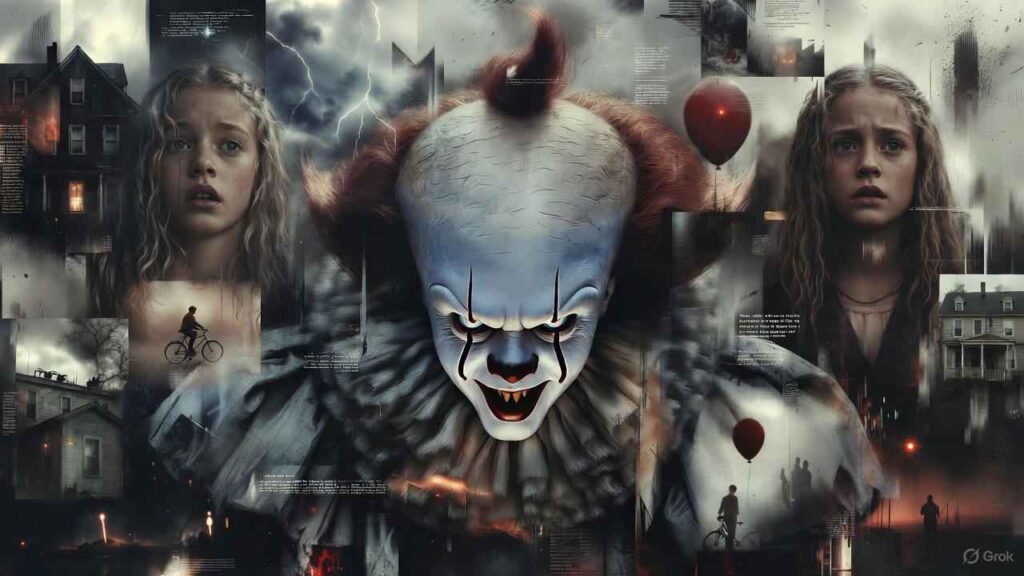
But the episode subtly reframes what that cage actually is.
The tree doesn’t end Pennywise’s existence.
It resets his position in time.
This is why Pennywise can be defeated repeatedly across generations and still return. His “death” isn’t an ending — it’s a displacement. A repositioning. A pause before the cycle begins again.
That’s why the finale feels strangely calm even in its chaos. Pennywise isn’t panicking. He’s adjusting.
Why Marge’s Revelation Changes the Entire Franchise
The most unsettling moment in the episode doesn’t involve violence at all.
It’s when Pennywise tells Marge Truman that she will grow up to have a son named Richie Tozier.
Longtime fans immediately recognize the name — one of the original Losers’ Club members from IT (2017) and IT: Chapter Two. But the implication goes far deeper than a clever callback.
Pennywise isn’t predicting the future.
He’s remembering it.
This single moment confirms that Pennywise experiences time all at once. He knows who will be born, who will suffer, and who will fight back — not because he’s omniscient, but because it has already happened to him.
That’s why fear sustains him. Not because it empowers him, but because it keeps the loop intact.
Rich Santos Isn’t a Savior — He’s Proof the Cycle Already Exists
Late in the finale, when all hope seems lost and the children struggle to plant the dagger, something impossible happens.
Rich Santos appears.
He runs across the ice, defiant, reckless, alive — helping from beyond his own time. The moment plays like a heroic return, but that interpretation misses the point.
Rich isn’t breaking the cycle.
He’s participating in it.
The children later recall feeling extra hands pushing alongside theirs. It wasn’t coincidence. It wasn’t divine intervention. It was resistance echoing across time — the same way trauma echoes across generations in Derry.
Rich doesn’t save them.
He proves they were never alone — and never free.
Beverly Marsh Was Doomed Long Before the Losers’ Club
The emotional core of the finale arrives quietly, almost cruelly.
We see Ingrid Kersh confined to Juniper Hill. Time jumps forward 27 years. Ingrid is older now, peaceful, painting in silence — until she hears crying.
She follows the sound into another room.
On the floor sits a young Beverly Marsh, sobbing beside her dead father.
Ingrid smiles gently and says the line that defines Derry more than Pennywise ever could:
“No one ever really dies in Derry.”
For fans of the films, this moment is devastating. It reframes Beverly’s encounter with Mrs. Kersh in IT: Chapter Two as something far darker than coincidence. Pennywise didn’t choose Beverly randomly as an adult.
He had already claimed her childhood.
This isn’t foreshadowing.
It’s confirmation.
The Finale Isn’t a Cliffhanger — It’s a Warning
When Marge later reflects on Pennywise’s nature, she describes his own death as his “birth.” It’s a line that quietly dismantles the idea of victory entirely.
If Pennywise exists outside linear time, then defeating him doesn’t remove him from the story. It simply moves the story elsewhere.
That’s why Lilly’s response is so chilling when Marge wonders if Pennywise could go back even further — targeting people before they’re born.
“I guess it’ll be someone else’s fight.”
This is the thesis of Welcome to Derry.
The fight never ends.
It only changes hands.
Derry Doesn’t Create Pennywise — It Sustains Him
By the end of the series, it becomes clear that Pennywise isn’t just a monster haunting Derry.
He is the manifestation of what Derry refuses to confront.
Racism. Abuse. Silence. Generational trauma. Fear passed down like inheritance.
Pennywise doesn’t need to conquer Derry.
Derry does the work for him.
That’s why he can lose battles and still endure. As long as fear remains unaddressed, as long as trauma is buried instead of healed, Pennywise will always have a place to return to.
What IT: Welcome to Derry Is Really Setting Up
Co-creator Andy Muschietti has hinted at a three-season plan — and the finale makes the direction clear.
Future seasons won’t move forward.
They’ll move backward.
Deeper into Derry’s past. Earlier cycles. Older wounds. Stories that existed long before the Losers’ Club — and long before Pennywise ever wore a clown’s face.
Because in Derry, time doesn’t heal anything.
It just repeats.
IT: Welcome to Derry is now streaming on HBO Max.
Do you think Pennywise can ever truly be stopped — or is Derry already beyond saving?